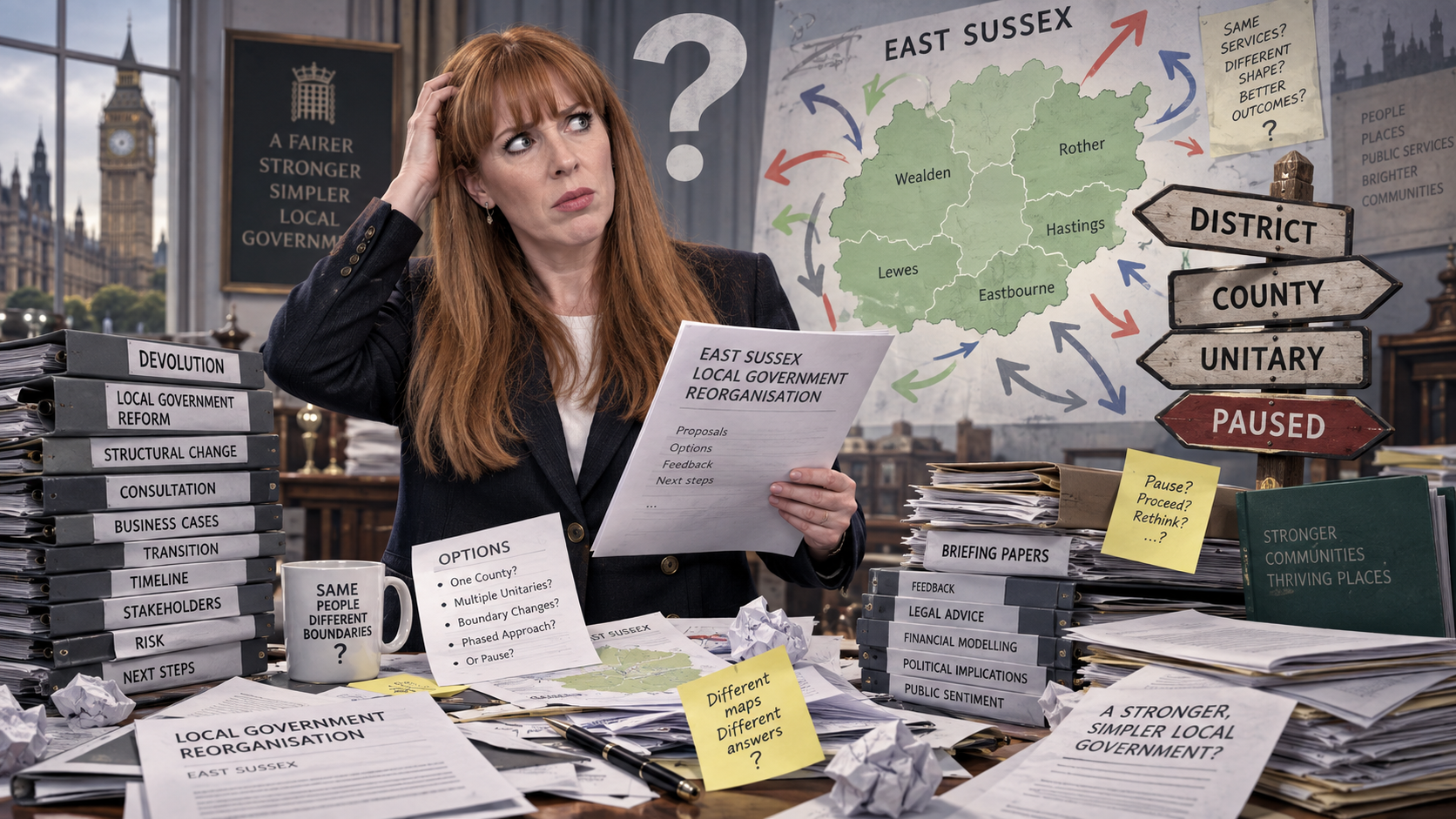
Local Government Reorganisation in East Sussex has descended into uncertainty.
For more than a year, councils across the county have been planning for the biggest restructuring of local government in decades. We were told that the existing county, district and borough councils would disappear, a new unitary authority would be elected in May 2027, and the new structure would take over in April 2028.
Now, suddenly, that timetable has been thrown into doubt.
On 7 September, the Government announced a review of its Local Government Reorganisation programme following updated legal advice. The plans affecting East Sussex have been paused. Crucially, the Government has also confirmed that the local elections scheduled for May 2027 will now go ahead on the existing council boundaries.
For Wealden, that has a very significant consequence.
Wealden District Council elections are now due to take place in May 2027.
That is a remarkable change from where we were only weeks ago.
From a final decision to a pause in seven weeks
On 16 July, the Government announced that it had selected a modified version of the One East Sussex proposal.
The plan was for almost the whole of East Sussex to become one unitary authority, replacing East Sussex County Council together with Wealden, Rother and Lewes District Councils and Eastbourne and Hastings Borough Councils. East Saltdean, Peacehaven and Telscombe would instead move into an enlarged Brighton & Hove.
Elections to the new authority were expected in May 2027, followed by a period operating as a “shadow authority”, before the existing councils disappeared in April 2028.
Councils were therefore instructed to start preparing for implementation.
Then, less than two months later, the Government changed course.
The Minister’s letter of 7 September could hardly be clearer. The Government has listened to concerns about both the approach and pace of reorganisation and decided that “now is the time to pause and reflect”.
The irony is difficult to miss.
Only weeks ago councils were being expected to devote considerable resources to implementing a decision that had effectively been presented as settled.
It no longer is.
What happens in May 2027?
This is perhaps the most immediate consequence for residents.
The original timetable envisaged the normal 2027 council elections being replaced by elections for the new shadow unitary authorities.
That is no longer the position.
The Government has specifically said:
“elections scheduled to take place in May 2027 will go ahead to existing council boundaries.”
For Wealden, elections to the whole District Council are normally held every four years and the next election is May 2027.
Unless the Government changes course again, residents will therefore be electing Wealden District Councillors in May 2027, rather than councillors to the proposed new East Sussex shadow authority.
That raises an obvious question.
What exactly are those councillors being elected to?
If LGR subsequently proceeds, they could potentially be elected to councils that the Government still intends to abolish.
If LGR is substantially revised or abandoned, the councils may continue for much longer.
At present, nobody can say with confidence.
What has all this cost?
There is another question which I think residents are entitled to ask.
How much has this process already cost?
Local Government Reorganisation does not happen simply by drawing some new boundaries on a map.
It requires extensive work on governance, finance, staffing, IT systems, property, contracts, service integration, legal structures, elections and organisational design.
Senior officers across East Sussex have been spending substantial amounts of time preparing proposals, consultations and implementation arrangements.
Consultants and external advisers may have been engaged.
Council meetings have considered LGR repeatedly.
Officer resources that might otherwise have been devoted to delivering existing services have inevitably been diverted into planning for an entirely new organisation.
Indeed, the Government itself acknowledges the problem. Its latest letter refers explicitly to reducing the risk of “nugatory work” if ministers subsequently decide to change course.
“Nugatory work” is Whitehall language.
Residents might describe it more simply:
work, time and money that could turn out to have been wasted.
We now need transparency from every council involved.
Residents should be told how much has been spent on LGR so far, how much officer time has been committed to it, what external consultancy costs have been incurred and what further expenditure has now been suspended.
The process has been badly handled
I have supported the principle of simplifying local government where there is a compelling evidence-based case that doing so will improve services, strengthen accountability and provide better value for taxpayers.
But that is precisely why the process matters.
Major structural change should follow rigorous analysis.
It should have a clear financial case.
It should properly consider the effect on services.
And once Government takes a decision of this magnitude, councils should be able to rely upon it.
Instead, East Sussex has been taken through proposal development, consultation, a further consultation, a Government decision, implementation planning and now a pause and review.
That is not how such a significant reform should be managed.
It creates uncertainty for staff.
It complicates long-term financial planning.
It distracts councils from delivering services.
And ultimately taxpayers pick up the bill.
There were already warning signs
There was also significant public opposition to parts of the final proposal.
The Government’s modified plan involved transferring Peacehaven, Telscombe and East Saltdean into Brighton & Hove.
During the further consultation on that proposal, 81% of respondents said they did not believe the modification would be an improvement, while 76% did not believe it would lead to stronger services or more sustainable finances.
Yet the modified scheme was nevertheless selected in July.
Seven weeks later, the entire programme is being reviewed.
That should prompt some serious reflection about how the decision-making process has operated.
What should happen now?
The priority now should not be another political rush to redraw the map.
Government should establish clearly what problem it is trying to solve and then determine what structure produces the best outcomes for residents.
For East Sussex, that means properly testing questions including financial sustainability, social care, children’s services, highways, planning, housing, democratic representation and the relationship between a very large unitary council and individual towns and communities.
It must also provide some basic certainty.
Councils cannot sensibly be asked simultaneously to run existing services, prepare for elections, plan their own abolition and speculate about what replacement structure the Government might eventually choose.
The Government says that the review is intended to ensure reorganisation is legally robust and consistent with its wider plans for devolution. That review should now be conducted properly rather than artificially rushed to meet another political timetable.
Residents deserve answers
For people living in Wealden, the practical position today is fairly simple.
Wealden District Council still exists.
It continues to provide its existing services.
Local Government Reorganisation has been paused.
And, as things currently stand, there will be elections to Wealden District Council in May 2027.
What is much less clear is what happens after that.
Having spent months telling councils to prepare for abolition, the Government has effectively pressed the reset button.
Before another penny is committed to another version of Local Government Reorganisation, residents deserve to know what went wrong, how much this exercise has already cost and why they should have confidence that the next plan will be any more durable than the last one.
Tell me what you think
Share your reaction to this article — read privately by me, not published as a public comment.