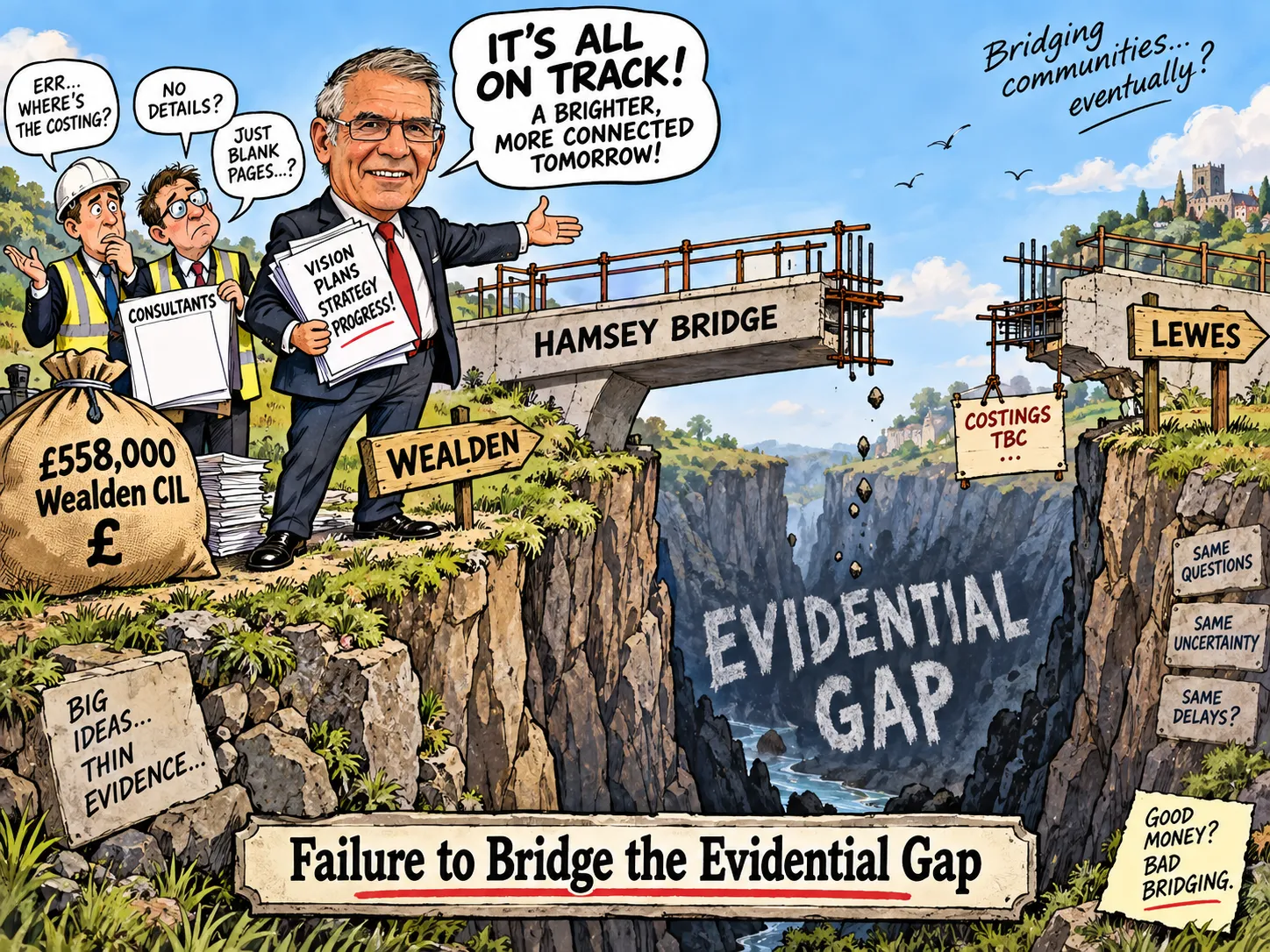
Scrutiny found reasons to look again. The Alliance majority voted not to.
Here is the Greenway decision in plain English.
Wealden Cabinet approved the allocation and use of up to £558,000 of Community Infrastructure Levy receipts towards Hamsey Bridge and Phase One of the proposed Uckfield to Lewes Greenway.
That CIL has accumulated because qualifying development has taken place in Wealden. The principal piece of infrastructure receiving this allocation, Hamsey Bridge, is in Lewes District.
That does not automatically make the expenditure unlawful. Wealden’s own legal advice is that CIL can support infrastructure outside the district where it supports development in Wealden. The real question is more demanding: why was £558,000 generated by development in Wealden committed to this project before residents or councillors were shown a clear comparison with competing infrastructure needs in Wealden itself?
At scrutiny, Cllr Kelvin Williams (Liberal Democrat) could not point to the bridge costing in the published consultant material. He repeatedly attributed the estimate to the consultants. Director of Place Chris Bending then gave a different explanation, saying Lewes District Council had led the costing work. The underlying Lewes costing was not before the committee.
We also heard that no formal landowner agreements had been reached for the wider route, there was no binding agreement between the participating authorities to deliver the whole scheme, and the Cabinet report itself contained two materially different recommendation structures because one was, according to Bending, a drafting mistake.
The motion at the end of scrutiny was not to cancel the Greenway. It was to ask Cabinet to reconsider its decision with those issues in front of it.
As Chair, I recorded all six Alliance members present voting against referral: Cllr Jessika Hulbert (Green), Cllr Christina Coleman (Green), Cllr Graham Shaw (Green), Cllr Mark Fairweather (Liberal Democrat), Cllr Gareth Owen-Williams (Liberal Democrat) and Cllr Ben Cox (Labour and Co-operative). Cllr Cox then moved no further action, Cllr Hulbert seconded him, and the same six-to-five majority carried it.
That is the core of this article.
The Alliance’s own Council Strategy says: “We want to be a Council you can trust.” It promises openness, honesty, transparency, value for money and financial responsibility.
Scrutiny exists to test whether those promises survive contact with a real decision.
What Wealden commissioned in 2024
The story starts in May 2024.
The Alliance Cabinet commissioned a scoping exercise to determine the feasibility and cost of a Greenway between Uckfield and Lewes. The brief was substantial. It included route assessment, landowner engagement, railway compatibility, bridge options, consents, a programme and timeline and, crucially:
“schedules and estimates of cost together with the necessary analysis to ascertain if the project is viable or not.”
That is a sensible sequence for a public project. Establish feasibility, cost and viability, then decide how much public money to commit.
The consultants did produce useful route work. They examined alignments, surfaces, drainage, land ownership and engineering constraints.
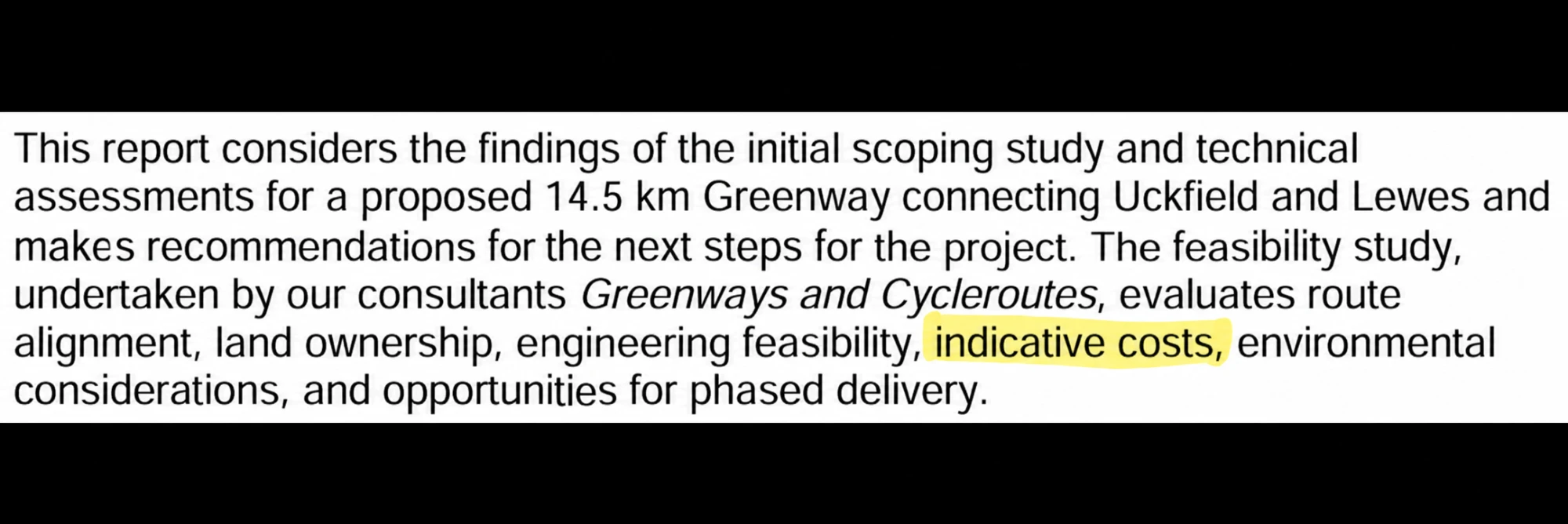
But the published material did not contain the cost schedule commissioned in 2024. It did not contain a quantified overall viability assessment. The 2026 Cabinet report nevertheless described the feasibility work as having evaluated “indicative costs” and recommended a specific £558,000 contribution to Hamsey Bridge.
The 2024 paper had also envisaged a later CIL decision going to Full Council after completion of the scoping work and any further supporting work. In 2026 the £558,000 decision was taken by Cabinet. The later report gave legal advice that CIL allocation is an Executive function, so I am not suggesting Cabinet lacked the power to decide. The point is that the process described to members in 2024 was not the process ultimately followed.
For me, this is where the project-control concern begins. Work specifically commissioned to reduce uncertainty was incomplete in the published record, yet the project moved on to a substantial allocation anyway.
Cabinet approved it without testing the central number
The Cabinet debate on 2 September was enthusiastic.
Williams called the Greenway a “really exciting project”. Council Leader Rachel Millward described it as “a really good project”. Greg Collins spoke about his own experience as a cyclist. Williams described Hamsey Bridge as the “most difficult bit” and the “most expensive bit”, and argued that building it would help create momentum for the future authority which inherits the project.
There were legitimate questions about an isolated bridge and railway safeguarding.
But Cabinet did not ask the basic financial question scrutiny later asked: where does the £558,000 figure come from?
Nobody asked to see the bridge costing. Nobody asked where the cost schedules commissioned in 2024 were. Nobody asked what the “most expensive bit” was being compared with. Nobody asked for a comparative appraisal of this use of Wealden CIL against other infrastructure priorities.
Cabinet approved the recommendations unanimously.
That is why scrutiny was necessary. It was not manufacturing objections after the event. It was asking questions Cabinet had not asked before making the decision.
The £558,000 figure did not survive simple questioning cleanly
At scrutiny I asked Cllr Williams where the bridge costing was.
He explained that prices can move, procurement would happen later and the Council was allocating rather than immediately spending the money. He described the figure as the “best guess at this moment in time.”
None of that identified the source.
Pressed again, he said it was the “best estimate in terms of our consultants”. He eventually accepted that the published consultant work contained no costing, but then again said the estimate was based on the consultants. Asked who had made the assessment, he replied:
“By the consultants that we’ve actually brought forward.”
The published consultant work did not contain it.
At that point Chris Bending intervened:
“I can help sort of break the deadlock to some extent.”
I did not think this was a deadlock. I had asked a factual question. Williams had attributed the figure to one source, but the published documents did not support that explanation.
Bending then said Lewes District Council had led the process of evaluating the bridge cost and that Wealden’s approach was to “fall in line with that process” rather than duplicate Lewes’s work.
There is nothing inherently wrong with relying on work undertaken by a partner authority. But reliance is not the same thing as assurance.
If Lewes’s work was the real basis for Wealden allocating £558,000, why was that provenance not set out clearly in the Cabinet report? Why was the underlying Lewes costing not available to scrutiny? We did not see the calculation, specification, quantities, contingency, inflation assumption or methodology behind the figure.
So the careful conclusion is not that no costing exists. It is that the basis of the figure was not demonstrated to scrutiny.
That is a serious weakness when the decision concerns more than half a million pounds of public infrastructure money.
Why I raised Farningham Road
During that exchange Williams challenged the suggestion that councils need to be wary of early-stage cost assumptions and asked whether I was, “dare I say, an expert in bridge building for cycleways.”
But I was not trying to price the bridge.
I referred to Farningham Road because public projects can become expensive once early assumptions harden into commitments. My point was simple: scrutiny does not need to be expert in bridge engineering to ask the Portfolio Holder to identify the evidence behind a number Cabinet has already used.
That is what scrutiny is for.
The project is still highly unresolved
The Cabinet report says the route is under third-party ownership and that:
“No formal access or land agreements have yet been reached.”
When I asked Williams whether some sections might never be delivered because landowners could refuse, he accepted that possibility.
Later, Cllr Michael Lunn asked whether agreements had been signed with the landowners needed for delivery. Bending answered:
“Absolutely not, no.”
Cllr Kevin Benton then asked whether the participating authorities were bound by an agreement requiring them to deliver the wider scheme.
Bending said:
“No, there’s no binding agreement.”
Again, none of this proves the Greenway cannot be delivered. But it shows how early the scheme still is.
The final alignment is unresolved. Land is not secured. Detailed bridge design is still to come. Flood and drainage work remains. There is no published overall scheme cost. The authorities are cooperating but are not bound to deliver the complete route.
That is a lot of uncertainty surrounding a decision already allocating and approving the use of £558,000.
Flooding, modal shift and the railway show the same pattern
The Cabinet report says the route “has been designed to be resilient to climate impacts, particularly flooding in the Ouse valley.”
The consultant material is more qualified. It says parts of the route flood for several days each year and that one section “will flood quite regularly”. Proposed measures include raised construction and surfaces intended to withstand inundation. Detailed design is still to come.
A flood-resilient path can, of course, still flood. The issue is the certainty of the wording. “Has been designed to be resilient” sounds like an engineering conclusion. The underlying material reads more like an intention to design for known flood conditions.
The modal-shift case has a similar problem. The report says the Greenway would reduce car dependency and encourage people to switch journeys to walking and cycling. Yet scrutiny was not shown a quantified assessment of expected use or displaced car journeys.
Instead, several Alliance contributions returned to personal cycling experience and examples from elsewhere.
Cllr Christina Coleman (Green) told the committee she had been “brought up cycling everywhere” and described the possible cultural change as a “wonderful gift”.
Cllr Graham Shaw (Green) cited the Cuckoo Trail and other long-term routes before concluding:
“Well, let’s make a start.”
Cllr Hulbert (Green) spoke about families, students, e-bikes and health benefits.
Those observations explain why members may like the idea. They do not replace evidence about expected modal shift, land deliverability or cost.
Railway safeguarding also remains important. The consultants worked on the assumption that a reopened Uckfield to Lewes railway would most likely be single track. During scrutiny, Bending described reopening as hypothetical and said it was “simply not in anybody’s forward plans.”
East Sussex County Council’s current Rail Strategy identifies Uckfield to Lewes reopening as a strategic priority, records it at feasibility-study stage and sets a five-year objective of progressing to a Strategic Outline Business Case.
That does not prove the railway will reopen. It does show why safeguarding it should be treated as a live strategic issue rather than a remote hypothetical.
Wealden CIL, Lewes infrastructure
This £558,000 is Wealden CIL.
Wealden collects CIL because qualifying development takes place in the district. The levy is intended to help fund the infrastructure needed to support development.
The principal Phase One asset receiving this allocation is Hamsey Bridge, in Lewes District.
That can be lawful. The legal question is not the point I am making.
The governance question is: where was the transparent comparison showing why this cross-boundary project should receive £558,000 generated by development in Wealden before identifiable alternatives within Wealden?
The Cabinet report itself says the available CIL balance is provisionally allocated across a number of potential infrastructure priorities and that competing demands must be prioritised.
Cllr Lunn asked Cllr Williams how that prioritisation had been undertaken. Williams said this project had come forward, there was sufficient CIL available and there were not other projects presently in front of him which warranted the money.
That is not the same thing as a documented comparative appraisal.
The consultants themselves identified an Uckfield section which could have value “whether or not the overall route to Lewes is achieved”. I am not saying that section should automatically have been funded instead. The published evidence does not allow that conclusion.
I am saying that the comparison should have been done and shown.
There is another useful contrast. When Lewes approved its own £558,000 contribution, its public case was strongly local: connecting Hamsey and Lewes, with discussion of safer access to Lewes services. At scrutiny I referred to the example used about Hamsey residents being able to cycle to Tesco in Lewes.
That is perfectly understandable from Lewes’s perspective.
But it also exposes the risk for Wealden. If the wider Greenway never materialises, Lewes may still have obtained the local bridge its councillors described. What will Wealden have obtained for its £558,000 if the connection back into Wealden remains incomplete?
The Cabinet report itself contained two different decision structures
Scrutiny also identified a problem in the report itself.
The recommendation attributed to Corporate Management Team said approval should be subject to remaining funding and necessary consents being secured.
The Portfolio Holder recommendation approved by Cabinet instead approved the allocation and use subject to partner contributions, then separately delegated to the Director of Place the due diligence, consents and agreements needed to deliver Phase One.
I asked why the recommendations differed.
Bending replied:
“That is a mistake.”
He said the Portfolio Holder version was the intended one.
This was not a spelling error. The two versions described materially different sequencing of safeguards around a Key Decision involving £558,000.
The significance becomes greater because the intended version delegated substantial implementation authority to Bending himself. Cabinet approved the use of the money, then delegated to the Director of Place the due diligence and the ability to negotiate, agree, approve and enter into the arrangements necessary to deliver Phase One.
Wealden’s Constitution gives Corporate Management Team a quality-assurance role over Key Decision reports. For me, the obvious question is how a report containing materially different recommendation structures, an unclear cost trail and substantial delegated authority reached Cabinet in that form.
Cabinet is responsible for the political decision. Officers are responsible for the professional advice and quality of the report supporting it.
Both parts of the process deserve scrutiny.
This was not merely “putting money aside”
A recurring Alliance defence was that the £558,000 was not actually being spent yet.
Williams said:
“It’s not actually about spending the money.”
Cllr Gareth Owen-Williams (Liberal Democrat) described the decision as “simply earmarking” money and “standard procedure”.
Cllr Ben Cox (Labour and Co-operative) repeatedly described it as “putting money aside” and said scrutiny was premature.
Those descriptions contain a truth: no cheque for £558,000 was being written that day.
But they leave out the formal decision Cabinet actually took.
Cabinet approved the allocation and use of up to £558,000 for Hamsey Bridge. It had already decided what the money was for. Much of the implementation within that ceiling was then delegated.
Owen-Williams himself established the opportunity cost when he asked whether earmarking the money meant it “can’t be spent on anything else” unless the project falls away or the decision is reversed.
Williams answered:
“Correct.”
That is why scrutiny was not premature. Once £558,000 is allocated to this project, it is not simultaneously available for another priority without another decision.
And what if the bridge costs more?
The Cabinet report contains an important safeguard: anything above £558,000 requires separate approval.
But Williams himself acknowledged that the £558,000 might not be enough. To explain why, he invited the committee to imagine “another Middle East crisis” sending steel prices “through the roof yet again”.
It was a remarkable detour. Asked to show scrutiny the cost estimate he repeatedly claimed was in the consultants’ work, Williams instead took us on an imaginary journey into future geopolitics.
Scrutiny was not asking him to predict the next war or guarantee the future price of steel. It was asking him to identify the evidence behind the £558,000 figure being approved today.
The cost estimate he said was in the published consultant material was not there. A hypothetical Middle East crisis did nothing to fill that evidential gap.
If the bridge costs more than £558,000, the Council will face another choice. The scope could change. Partners could be asked for more. Another funding source could be sought. Or the bridge could stall.
There is no binding agreement before scrutiny explaining how a future overrun would be shared.
The danger is not that Wealden has already signed a blank cheque. It has not.
The danger is that by the time a higher-cost decision returns, the project may have accumulated design work, officer time, partner expectations and political commitment. The later decision will not be made from a blank sheet of paper.
That is how public projects can acquire momentum faster than certainty.
A familiar decision structure
There is a comparison here with another recent Wealden decision.
In September 2025 Cabinet approved up to £450,000 from earmarked reserves for the Winnie-the-Pooh centenary programme. The report said the figure had been reached through detailed discussions with The Ashdown Forest Foundation and its creative partner. It did not itself set out an itemised public breakdown showing how the exact £450,000 had been built up. Instead, final funding arrangements, including the grant agreement, were delegated to officers in consultation with the Portfolio Holder.
The report also said some parts of the programme needed “funding certainty now”, while other elements were still expected to secure separate funding from other organisations. It acknowledged that £450,000 was a large sum to award to a relatively small organisation and said the spending controls in the later funding agreement would therefore be essential. Payments were to be made in arrears.
That project is not identical to the Greenway and it would be wrong to pretend otherwise. The Pooh funding had a defined cultural programme, payments in arrears and an explicit recognition in the report of the financial-control risk. But the decision-making structure is familiar: make a substantial commitment first, then rely on later agreements, controls and detailed arrangements to manage what has not yet been finally settled.
The Greenway raises the same structural question in a more complicated infrastructure setting. Cabinet has allocated and approved the use of £558,000 while the underlying bridge costing was not demonstrated to scrutiny, the final route remains uncertain, land is not secured, the participating authorities are not bound to deliver the whole scheme and the ultimate cost of the wider project is unknown.
For me, the concern is not that councils should never commit money until every last detail is fixed. No serious infrastructure project could proceed on that basis. It is that early uncertainty should be reduced before commitment grows, not normalised on the assumption that the difficult detail can always be dealt with later.
What scrutiny is for, and why the result troubles me
Wealden’s Constitution says scrutiny should act as a “critical friend” to Cabinet and hold the Executive to account. Its own guidance tells scrutiny members to be persistent, inquisitive and open-minded.
That is the standard.
Against it, some of the contributions during the meeting were revealing.
Immediately after the difficult costing exchange, Cllr Owen-Williams said:
“I hope we’re not going to spend too long on this.”
After Bending confirmed there were no landowner delivery agreements, discussion returned to cycling benefits.
Cllr Cox described the debate as premature, referred to “politics for the sake of politics”, later said referral would be “putting pressure where pressure is not really needed”, and ultimately moved the motion for no further action.
Cllr Hulbert chairs Wealden’s Audit and Governance Committee, whose role includes high-level oversight of governance, risk and control. She voted against referral and then seconded Cox’s no-further-action motion.
The Alliance Agreement adds a further governance question. It states:
“Members dissenting from a particular decision or proposal must discuss the matter in advance of any Council or committee meeting with the relevant portfolio holder”
I do not know whether that rule affected any individual’s vote.
But scrutiny is supposed to be capable of changing a member’s mind. Evidence emerges during the meeting. An officer may clarify something. A Portfolio Holder may give an unexpected answer.
A requirement to discuss dissent in advance sits awkwardly beside a process which is supposed to leave members open to changing their view because of evidence heard on the day.
Then came the votes.
As Chair, I recorded all six Alliance members present voting against referring the decision back to Cabinet. Cllr Cox then moved no further action. Cllr Hulbert seconded him. The same six-to-five majority carried it.
The votes did not answer the unresolved questions.
They ended the call-in.
Why I wanted Cabinet to look again
My referral motion did not seek to cancel the Greenway.
It asked Cabinet to reconsider the decision with the issues uncovered by scrutiny addressed: the cost evidence, route options, land position, flood and railway issues, CIL prioritisation and the safeguards around later due diligence.
Cabinet could have considered all of that and approved the same £558,000 again.
That is why I find the result so difficult to justify.
The Council commissioned cost and viability work in 2024. The published evidence in 2026 did not contain all of what had been commissioned. Cabinet approved £558,000 without testing the provenance of the bridge figure. Scrutiny then exposed uncertainty over that figure, land, agreements, governance and future cost risk.
The modest response available was to ask Cabinet to reconsider.
The Alliance majority chose not to.
My conclusion is not that the Greenway will fail. It may eventually prove a successful project and good value.
My conclusion is that the project is acquiring commitment faster than it is acquiring certainty.
That is precisely when scrutiny should matter most.
Residents can read the papers and watch both meetings themselves. I chaired the scrutiny hearing from beginning to end. On the evidence I heard, I believed Cabinet should have been asked to look again.
Sources for publication
- Wealden District Council, Proposed New Cycleway to Link Uckfield and Lewes, Cabinet report, 8 May 2024
- Wealden District Council, Uckfield and Lewes Greenway, Cabinet report, 2 September 2026
- Wealden District Council, Cabinet webcast, 2 September 2026
- Greenways and Cycleroutes, consultant workbooks for Sections 1 to 4 of the proposed Uckfield and Lewes Greenway
- Wealden District Council, Scrutiny and Performance Committee webcast, 21 September 2026
- Wealden District Council Constitution, scrutiny and Executive functions
- Wealden District Council Constitution, scrutiny checklist
- Wealden District Council, Council Strategy 2023-2027
- Wealden District Council, Community Infrastructure Levy
- Wealden District Council, political groups
- East Sussex County Council, East Sussex Rail Strategy 2025-2050
- Lewes District Council, Cabinet papers and webcast, March 2026
- Alliance for Wealden Agreement, provision on dissent from decisions or proposals
- Wealden District Council, Winnie-the-Pooh’s 100th birthday to be celebrated by a long-lasting legacy programme for the Ashdown Forest, 8 September 2025
Tell me what you think
Share your reaction to this article — read privately by me, not published as a public comment.