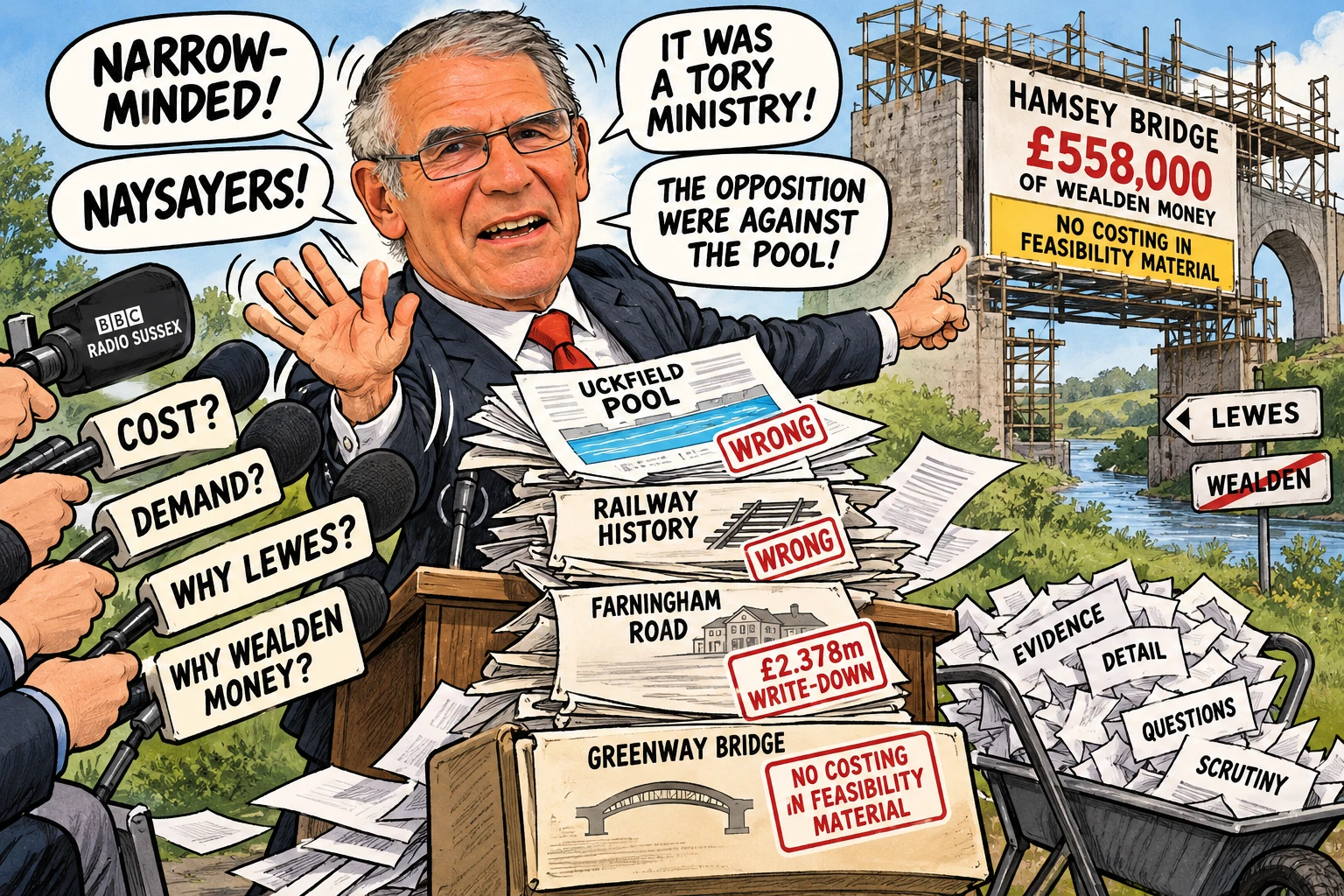
On 21 September, Wealden’s Scrutiny and Performance Committee examined the Cabinet decision to allocate and potentially use up to £558,000 of Wealden Community Infrastructure Levy receipts towards the proposed Hamsey Bridge.
I chaired that meeting and was a signatory to the call in to examine the decision along with 4 other councillors. The issue was not whether cycling is a good thing, or whether a traffic-free route between Uckfield and Lewes would be desirable. It was whether this particular decision was supported by adequate evidence, whether £558,000 represented a justified use of Wealden’s infrastructure money, and whether sufficient safeguards existed before that money could actually be spent.
Eight days later, Cllr Kelvin Williams, the Portfolio Holder responsible for the decision, appeared on BBC Radio Sussex to defend it.
By then, he knew exactly what the concerns were. Yet when presenter Danny Pike asked some remarkably similar questions about the evidence for demand and the justification for spending Wealden money on infrastructure in Lewes, Williams repeatedly moved away from those questions and onto his political opponents.
He described the opposition’s approach as “narrow-minded”. By the end of the interview, critics had become “naysayers” who “come out of the woodwork”.
That is quite a way to describe councillors doing precisely what a scrutiny committee exists to do.
Pike asked Williams a particularly straightforward question: “Is there evidence that the greenway will be well used? Is there a demand for it?”
Williams began his longwinded answer: “Personally, I’ve not actually met anyone that’s against it…” He then moved into railway reopening, the history of the railway closure, the feasibility study and partner funding.
But whether Cllr Williams has personally met somebody who opposes the Greenway is not evidence of demand. Nor was that what he had been asked.
Wealden has allocated up to £558,000 of infrastructure funding towards a bridge outside the district. Asking what evidence exists for the anticipated public benefit is hardly unreasonable.
What Scrutiny had already established
The radio interview is particularly interesting because of what had happened just eight days earlier.
At Scrutiny, I asked Williams to show me where the bridge was costed in the consultant feasibility material presented with the Greenway proposal.
The exchange became remarkably protracted. Williams described the figure as the “best estimate” and referred to the consultants. I kept asking a much simpler question: where was the costing in their work?
Eventually, when I said there was “no costing at all in the feasibility study”, Williams replied: “I’ve accepted that”. When I subsequently pointed out that there was “no financial costing at all, anywhere in the consultant’s work”, he replied: “I accepted that too.”
An officer then provided an important clarification. Lewes District Council had separately led the process of evaluating the bridge cost because the bridge itself is in Lewes District, and Wealden had followed that work rather than duplicating it.
That explanation doesn’t alter the point I was making. The consultant feasibility material upon which the Greenway proposal was presented to Wealden Cabinet contained no financial costing for the bridge.
Asking how £558,000 was arrived at is not “naysaying”. It is precisely the sort of question Scrutiny should ask before public money is committed.
Williams then used his BBC interview to portray the Greenway challenge as part of a wider pattern of opposition. He claimed that the opposition had also been “against the saving of the Uckfield swimming pool”.
There is a rather obvious problem with that claim.
Following the 2023 elections, a motion was brought to Wealden Full Council specifically seeking to keep Uckfield Leisure Centre open. It was proposed by Cllr Ben Reed, an opposition councillor, and seconded by Cllr Spike Mayhew, then also an opposition councillor. The motion called upon the Leader and Chief Executive to explore every possibility to keep Uckfield Leisure Centre, including its swimming pool, open. Contemporary reporting records that the motion was approved by councillors.
So when Williams says the opposition were “against the saving” of the pool, I think he needs to explain precisely whom he means and what evidence supports that statement. The recorded actions of opposition councillors tell a rather different story.
Then came the railway.
Williams told BBC listeners that the Uckfield-Lewes line had been closed “against British Rail’s recommendations” by “the then Tory ministry”.
History records the events rather differently. The minister responsible when the closure was authorised was in fact Richard Marsh, Minister of Transport in Harold Wilson’s Labour government.
There is a more complicated history surrounding the road scheme, British Rail and the eventual closure of the railway, and that wider history can legitimately be debated. But Williams chose to make a specific party-political claim. The attribution he gave listeners does not match the historical record.
If you are going to use history as part of a political attack, getting the history right seems a reasonable minimum requirement.
And what exactly is South Downs ‘reconsidering’?
Williams also made a striking claim about the third partner in the proposed bridge project.
“The South Downs National Park voted earlier this month to not offer their third of the funding,” he said. “They’re reconsidering that, and that’s what we’re waiting on.” He went on to say that if the National Park did not “come up to the table with their share”, the project probably would not proceed.
The position shown in the South Downs National Park Authority’s own September CIL papers is more complicated.
Hamsey Bridge is identified within the Authority’s wider infrastructure programme, but when its Planning Committee considered the allocation of 2025/26 CIL receipts on 10 September, the bridge was consciously not selected for an allocation in that funding round.
The report had £2,096,940.11 available to allocate. It recommended £2,026,886.11 for 16 projects, with £70,054 placed into a pot for future “Essential projects”. The report says the projects selected included those which scored highest in the priority matrix, could be delivered in the short term and/or helped provide a broad geographical spread across the National Park.
So this was not simply a case of Hamsey Bridge being unknown to South Downs or omitted from its infrastructure planning. The project was in the programme, a CIL allocation exercise took place, and other projects were selected for funding.
That makes Williams’s statement on 29 September that South Downs was ‘reconsidering’ its refusal worth pinning down. Perhaps there were subsequent discussions. Perhaps another funding route was being explored. But the documented September position was that the bridge had not been selected for an allocation in the 2025/26 CIL round.
There is an additional contrast. The South Downs report says even projects receiving an in-principle allocation are subject to further assessment before payment, including checks on project costs and adequate quotations. It says projects seeking CIL money must be supported by ‘clear evidence of the cost and practicality of delivering the scheme or project’.
At Wealden Scrutiny eight days earlier, Williams had accepted that the consultant feasibility material presented to Wealden contained no financial costing for the bridge.
One authority had Hamsey Bridge within its infrastructure programme and did not allocate CIL to it in this funding round. Another (Wealden) allocated up to £558,000 towards it despite there being no bridge costing in the consultant feasibility material presented to members.
Wealden’s own decision also makes its contribution conditional upon South Downs formally committing its matching contribution. So if South Downs really is ‘reconsidering’ the position, there is a straightforward question for Williams: what exactly is being reconsidered, through what process, and from what funding source?
Until a further commitment is actually made, Wealden has earmarked up to £558,000 while the third matching contribution on which its decision depends remains unsecured.
Scrutiny is not “naysaying”
This is why I found Williams’s language about his critics particularly disappointing.
At Scrutiny on 21 September, we examined the absence of a bridge costing from the consultant feasibility material, the dependence upon third-party land, the conditions that would have to be satisfied before money could be released, the uncertainty over partner funding and the opportunity cost of allocating £558,000 of Wealden CIL to this project.
Those are not obscure technical objections manufactured to frustrate a cycle route. They are questions about evidence, risk and public money.
Williams is perfectly entitled to disagree with the conclusions individual councillors draw from that evidence. But describing those asking the questions as “narrow-minded” or “naysayers” does not answer any of them.
There is also a wider context to my concern about financial scrutiny.
Farningham Road was delivered under Williams’s Asset Management portfolio. More than £4.5 million was spent constructing the industrial units. The Council’s subsequent accounts recorded a £2.378 million downward fair-value adjustment, resulting in a valuation of approximately £2.170 million.
A fair-value adjustment is not the same thing as saying £2.378 million of cash simply disappeared. But a project costing more than £4.5 million receiving an initial valuation of around £2.17 million is something elected members are entitled to examine when considering the handling of major capital projects.
That is not “naysaying” either. It is our job.
Strip away the political rhetoric and the Greenway questions remain remarkably straightforward.
Wealden has allocated up to £558,000 towards a bridge situated in Lewes District. The consultant feasibility material contains no financial costing for that bridge. The wider route remains dependent upon land agreements, further work and partner participation. South Downs had Hamsey Bridge within its infrastructure programme but did not select it for a CIL allocation in its September funding round. And when BBC Radio Sussex asked Williams for evidence of demand, his answer began with the fact that he personally had not met anybody against the scheme.
Eight days earlier, Scrutiny had tested many of these same issues.
Williams’s response on the radio was to describe his political opponents as “narrow-minded” and critics as “naysayers”, while making a claim about Uckfield Pool that sits uneasily with the recorded actions of opposition councillors and incorrectly attributing the railway closure to a Conservative ministry.
For me, this demonstrates precisely why scrutiny exists.
When decisions involve hundreds of thousands, or millions, of pounds of public resources, the evidence should withstand difficult questions. Accuracy matters. The basis for financial decisions is important and should be questioned. And councillors should be able to challenge those decisions without being dismissed simply for doing their job.
Cllr Williams is perfectly entitled to defend his Greenway decision.
But attacking the people asking the questions does not answer them. And deflecting and getting the facts wrong in your counter argument certainly does not make those questions go away.
Listen to the radio interview here
Tell me what you think
Share your reaction to this article — read privately by me, not published as a public comment.