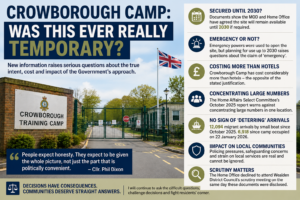
By now you will probably know that there was a significant development obtained from legal documents sent to Wealden District Council as part of the ongoing judicial review proceedings relating to Crowborough Training Camp.
Buried within those papers was information indicating that the Ministry of Defence and Home Office had agreed that Crowborough Camp would remain available until 2030 if required. It is important to recognise that the documents do not explicitly say that Government has made a “final decision” to use Crowborough Camp until 2030.
What they do show is something slightly different. They appear to show that Government has already taken steps to ensure the site remains available until 2030 if it decides that it needs it. But being honest, I am unconvinced that the distinction is as meaningful as Ministers (and those who work in the Home Office) would perhaps like people to believe.
Throughout this process we repeatedly heard the same line that no decision had been made. That point was made again and again by Ministers including Shabana Mahmood and Alex Norris. Technically, perhaps that remains true in the narrowest possible sense. But technical correctness and public trust are not the same thing.
If Government is making arrangements to preserve the use of a site until the end of the decade, people will naturally ask what exactly “no decision has been made” was intended to mean.
And this is increasingly where my frustration sits.
People do not expect politicians to tell them what they want to hear. Difficult decisions are part of governing. But people do expect honesty. They expect to feel that they are being given the whole picture rather than carefully selected parts of it.
Since this first arose, most people locally have understood Crowborough Camp to be a temporary arrangement. We were told about a twelve month period. We were told about emergency pressures and a short-term response to exceptional circumstances. The Government’s own screening documents described the proposal as “temporary (up to 12 months)” accommodation and relied on the assumption that the site would return to its previous use afterwards. Not least to give Crowborough’s Cadets their home back.
That temporary nature appears to run through almost everything that followed. Questions around traffic, impact on the surrounding area, cumulative effects and wider community impacts all seem to have been considered on the basis that this was a short-term measure.
But preserving a site’s availability until 2030 feels rather different.
Perhaps Government will continue saying that no decision has been made. Perhaps it will continue saying this is merely contingency planning. People can make up their own minds on that. Having become somewhat cynical, I know I have. But there seems to be a fairly obvious difference between saying that no decision has been taken beyond twelve months and quietly ensuring that the site remains available for another four years if required.
There is another question sitting behind all of this which is perhaps even more uncomfortable.
If departments are already planning around the possibility of needing accommodation capacity through to 2030, what exactly does that tell us about expectations around illegal migration and small boat crossings? Because it certainly does not suggest anyone believes current pressures disappear any time soon. The consequences of national policy decisions do not simply disappear into Whitehall papers and ministerial statements. Eventually they land somewhere. In this case they landed in Crowborough.
There is another point which I think deserves much more attention.
From the beginning, much of the justification for this approach rested on urgency and emergency measures. The argument was effectively that exceptional circumstances required exceptional action. Most people can understand that principle. Emergencies sometimes require governments to move quickly. But emergencies are usually temporary by definition. They are supposed to deal with an immediate problem while a longer-term solution is found.
If Government departments are already preserving the availability of Crowborough Camp through to 2030, then a fairly straightforward question starts to emerge.
At what point does an emergency stop being an emergency?
Because a planning horizon stretching years into the future starts looking less like a short-term response and more like the gradual creation of a semi-permanent system. In effect it functions as infrastructure serving a problem the root cause of which cannot be managed by Government. Government fails – communities pay.
There is another uncomfortable question that follows.
Part of the wider justification for this approach was pressure on public finances and reducing reliance on “expensive” hotel accommodation.
Yet the information we have received suggests that Crowborough Camp has actually cost considerably more than the hotels it was intended to replace. If the emergency argument was that hotels were placing unacceptable pressure on the public purse, replacing them with accommodation that costs even more (and in Crowborough’s case twice as much) becomes difficult to reconcile.
The Home Affairs Select Committee also raised concerns in its October 2025 report around concentrating large numbers of asylum seekers in single locations rather than dispersing accommodation more widely.
Again, I come back to the same issue.
People can accept difficult decisions if they understand the reasoning. But once the stated reasoning and the practical outcome start drifting apart, trust evaporates.
There is also another issue which increasingly deserves scrutiny.
Back in October 2025, part of the justification for sites such as Crowborough was that moving away from hotels and into more basic accommodation would help reduce so-called “pull factors”. The argument was that a different accommodation model would contribute towards bringing the system under control.
Again, people can make up their own minds on immigration policy itself. My point here is much simpler. If a policy is introduced with a particular objective, it is reasonable to ask whether it is actually achieving that objective?
According to official Government figures published on English Channel small boat crossings statistics there have been 12,094 migrant arrivals by small boat since the announcement in October 2025 that Crowborough Camp would form part of this approach. Taking the point at which Crowborough Camp itself became occupied on 22 January 2026 there have been 6,918 arrivals.
Those figures alone do not prove cause and effect, but they do raise a perfectly reasonable question.
If emergency powers are being used, if local communities are being asked to absorb impacts, if the costs appear higher than the accommodation model they replaced and if sites are now being preserved until 2030, where exactly is the evidence that the wider objectives are being achieved?
There is also another reality that should not simply be ignored because it is uncomfortable to discuss.
Across the country there have been well-publicised issues associated with some asylum accommodation sites. There have been policing concerns, safeguarding issues, public disorder incidents and pressures placed on local services. I want to be sensible here. None of that means asylum seekers as a whole are responsible for those things and it would be wrong to suggest otherwise. But pretending risk does not exist helps nobody either.
If the site operated at full capacity with 540 men and they stayed on average between 70 and 90 days, somewhere between around 11,000 and 14,000 men could potentially pass through Crowborough over a five-year period. The town’s total population is approximately 22,000 people.
That should not be used to create alarm. But equally it should not simply be brushed aside.
Increasing numbers and increasing duration naturally increase the possibility of incidents, pressures and unintended consequences. Police resources are not unlimited and additional demands do not appear from nowhere. Communities often end up carrying practical burdens and costs that were never really discussed (or properly costed) at the outset.
There is one final point which I personally find increasingly difficult to ignore.
On Monday morning I chaired a meeting of Wealden District Council’s Scrutiny Committee to discuss Crowborough Camp and the wider impacts on the district.
The Home Office declined to attend at the last minute.
On that same day, judicial review documents were sent to Wealden containing material which appears to indicate that the site had already been secured for availability until 2030 if required.
I personally find that impossible to ignore.
The Home Office may not have any legal obligation to attend scrutiny, but they miss the point entirely. Scrutiny exists so decisions affecting communities can be tested openly. Questions should be asked and assumptions should be challenged. Increasingly I am left with the impression that democratic scrutiny around this decision is being treated as something to avoid rather than something to embrace.
There is also now a question for the leadership of Wealden District Council itself. Councillors Millward, Partridge and the Cabinet.
The Council has already become involved in these proceedings as an Interested Party and has now seen legal material which appears to suggest the longer-term picture may look rather different from what many residents originally understood.
Does that change anything? Should Wealden simply continue observing events from the side-lines, or should it now consider taking a more active role in defending the interests of local residents and the district?
I opposed the use of Crowborough Camp from the beginning and nothing I have seen changes my view.
But my job as a councillor is not simply to tell people what they want to hear.
My job is to ask difficult questions when others would rather avoid them, challenge decisions, push for transparency and make sure local people have someone willing to speak plainly on their behalf.
I have done that from the start and I will continue doing it. Whatever comes next…..
3 responses to “Crowborough Camp: was this ever really temporary?”
-
None of this surprises me Andrew. We have unfortunately been lied to by the HO right from the very start. It’s outrageous behaviour and should not be stood for.
-
I cannot understand why this Government thinks it’s OK to dump 600 unknown illegal immigrant single males, without restraint, in a small rural town. Why are they prioritising the welfare of these men above the welfare of the people they’re meant to serve?,
Why has the Home Office abandoned the ‘homeland security ‘ part of their remit in favour of allowing anyone and everyone to come here, and giving them freedom (and money) to roam.
It’s impossible to make sense of it all. -
I have contacted the PCC because she needs to know that the migrant camp is likely to be opened much longer than originally planned.
Also the extra funds of £5m for police funding now seems doubtful.
The PCC should definitely attend a special meeting of the scrutiny committee.


Leave a Comment